The idea of a slow tech workspace has grown quietly out of the feeling that too much speed leaves us unfocused. Many desks today are built around efficiency, shortcuts and constant switching, yet the mind rarely thrives under that pressure. A slower approach doesn’t mean abandoning technology; it means creating an environment in which devices blend into the rhythm of the room instead of pushing it forward at full force.
Natural materials, clear surfaces and stable structures all contribute to that shift. They help move the focus from what demands attention to what supports it. A workspace shaped this way feels less like a place where tasks are rushed and more like a setting that gives them space to unfold.
When the pace around you softens, you notice different things. The sound of a pen on wood, the warmth of a raised platform under a monitor, the calmness of a surface that doesn’t wobble when touched. These details don’t slow work; they steady it. And when the environment steadies, thinking becomes more fluid.
Slow tech workspace – a desk shaped by presence, not pressure
A slow tech workspace begins with presence. It encourages you to choose tools deliberately, to place them where the hand expects them to be, and to notice how the desk responds when objects stay in a stable rhythm.
There is no rush to clear everything away, nor any pressure to fill empty areas. The surface breathes. Items rest in places that feel natural. Your gaze moves more easily across the desk because nothing demands to be processed immediately.
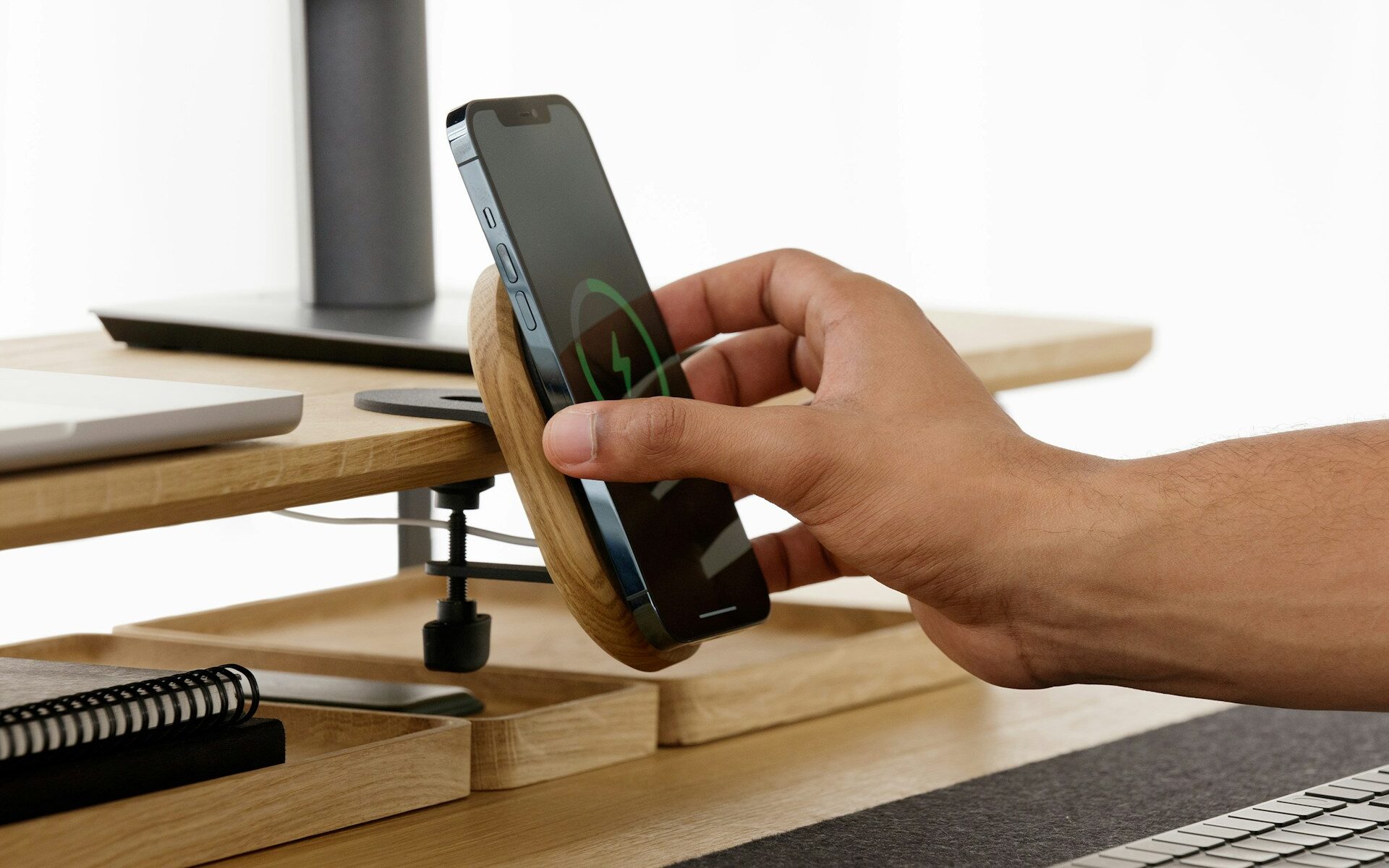
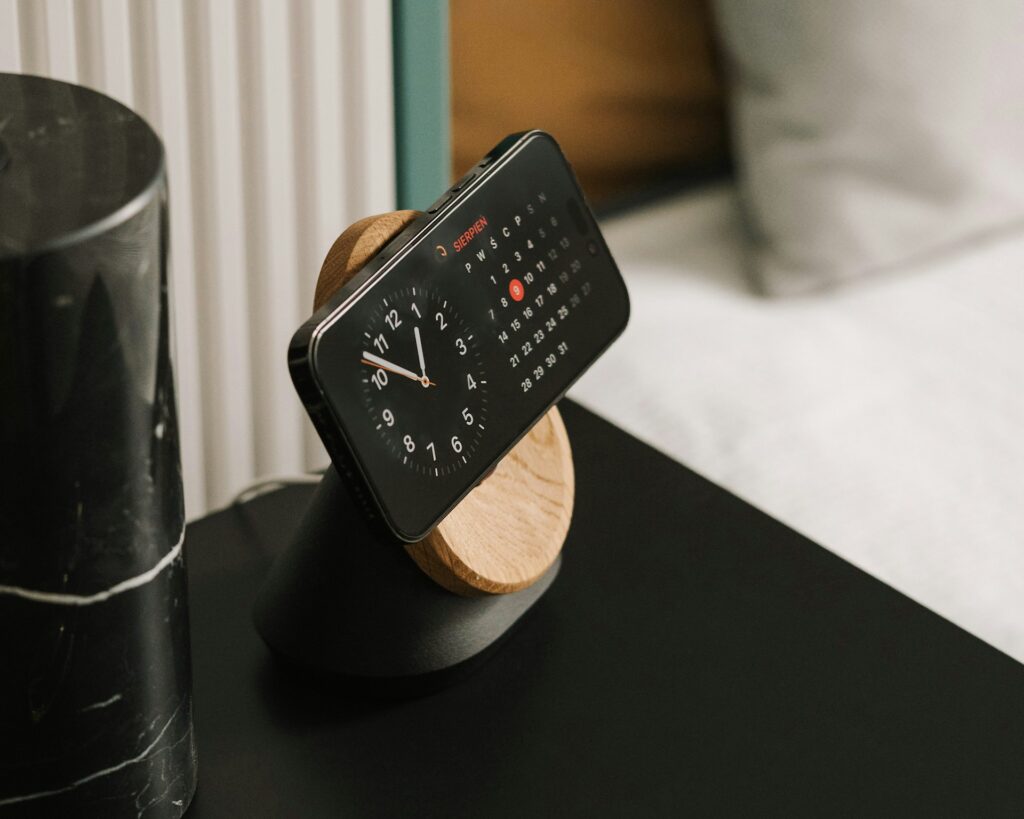
Even the act of lifting a device changes when the environment is calmer. A phone picked up from a quiet charging stand, a laptop resting on a wooden platform, a notebook sliding across a smooth surface — the gestures feel grounded. And grounded gestures affect the whole working pace.
A desk that listens rather than competes
The space around you stops pushing forward and begins to support steadier movement.
Designing a slower rhythm through material and height
A slower workspace often emerges from the materials that shape it. Wood introduces warmth and a sense of weight, encouraging slower gestures. Felt softens sound. Steel creates stability without shouting for attention.
These textures never overwhelm; they steady. When combined with layers of height — a raised shelf for screens, a clear surface for writing, a lower zone for accessories — the desk gains a gentle structure. Tasks fall into place more naturally, and switching between them feels less abrupt.
This is the quiet advantage of a slow-paced workspace. It doesn’t limit productivity. It guides it. The desk becomes a landscape instead of a flat surface loaded with tools, and landscapes always provide direction.
Materials become part of the tempo
Textures influence how quickly or slowly your hands move, reshaping daily flow without you noticing.
Slow tech workspace – easing the mind through calmer interaction
One of the reasons digital fatigue builds so quickly is constant switching. Notifications, tabs, cables, screens, accessories all invite micro-attention. A slow tech workspace reduces the invitations.
Devices have designated places to rest. The layout uses clear lines, soft boundaries and stable forms to create gentle zones of attention. When the phone is not needed, it rests further away. When a tool is meant to be used often, it sits within a natural hand’s reach.
As the workspace becomes more intuitive, interaction with technology becomes less reactive. You avoid the quick, jittery movements that often accompany busy desks. Instead, you approach each object with clearer intention, and that intention creates calm.
Fewer jolts, more coherence
The desk stops interrupting your thought process and begins to guide it.
Letting analogue and digital coexist without tension
A slow approach makes room for both digital tools and analogue ones. A notebook doesn’t feel old-fashioned on a modern desk; it becomes a different pace within the same rhythm.
The key is separation without distance. Digital tools live in one gentle zone, analogue in another. Neither overlaps unless you choose it. The result is not division but ease — a way of working that allows both to exist side by side without competing for dominance.
This coexistence encourages the mind to shift modes more smoothly. You move from typing to sketching, from reading on a screen to noting thoughts on paper, without feeling torn between worlds. The desk becomes a bridge rather than a battlefield.
Each tool contributes to the tempo
When no item demands urgency, the whole environment becomes calmer.
Slow tech workspace – a way of working that grows with you
The most compelling aspect of a slow tech workspace is how naturally it evolves. It doesn’t lock you into a rigid system. As your work changes, the desk adapts.
Some weeks you need more space for screens; others call for more paper. Sometimes the desk supports long, focused hours; sometimes it becomes a softer base for planning and thinking. The slow approach makes room for all of it.
Over time, the workspace begins to mirror your habits. Not the rushed ones, but the steady ones — the gestures you repeat without noticing, the natural flow your hand prefers, the comfort your eye finds in lines that don’t feel forced.
A desk that settles into your rhythm
You shape the space, and the space quietly shapes your pace.
Slow tech workspace – a calm foundation for complex work
Slowing the pace of the workspace doesn’t mean reducing ambition. It means refining the environment so that ambition does not burn through your energy too quickly.
A desk that welcomes slower gestures allows for deeper thinking. A surface that stays still encourages concentration. Tools that rest in predictable places free the mind from constant orientation. The result isn’t slower work — it’s steadier work.
By the end of the day, you feel the difference not in how much you accomplished but in how you arrived there. With more clarity, less agitation, and a workspace that didn’t drain you while you moved through it.
A slow tech workspace becomes less of a trend and more of a personal rhythm — one that continues long after the laptop closes.